Friday August 3, 2007
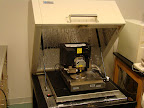
Lots of work today. By 9AM we had set up the 0.08% surfactant solution in the Hasbrouck lab and returned to Conte. Each of us again spin coated 3 films of 1.4% polystyrene in toluene, then returned to Hasbrouck to float and wrinkle. The more surfactant present, the greater the difficulty floating the films, but the easier it is to manipulate the films into position under the microscope. I had success with two films, Dave was able to complete the wrinkling protocol for one film, and Efren's films just would not let go of the glass slide. We decided that it was necessary to increase the angle of the slide as it entered the water, and I found that I had to use the probe to move the liberated film away from the glass surface so that it would not re-adhere before I could remove the slide from the water.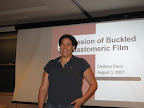
A noon lunch of pizza was followed by a presentation by Chelsea, who is a first year PhD candidate from N.C. State. She has a BS in Textile Engineering and has worked in industry for several years since her graduation. She is affiliated with the Crosby Group and is working on the interactions that occur at the interfaces of soft matter. She took a few minutes to explain a little more about the PhD program; there are 30 hrs of coursework during the first year, including classes in Polymer Synthesis Chemistry, Materials Engineering, Polymer Physics, Synthetic Chemistry and Polymer Characterization. This is a heavy load for first year students. In addition to the coursework, they are beginning research and working to decide which area of polymers they will focus on for their PhD (this also includes selecting one of the professors to serve as research supervisor).
After Chelsea's presentation, we attended the Crosby group meeting to see Renee, Mary and Lauren present the results of their research. Their experience here has been quite different from ours. They have made several discoveries which Dr. Crosby believes to be worthy of publication. Their research project is entitled "Long Range Alignment of Surface Wrinkling".
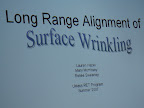
During their experiments, they have used PDMS (polydimethylseloxane) films about 1mm thick, which they have then subjected to horizontal stress. After stressing, the PDMS is soaked in ethanol to induce swelling. Cracks form in the PDMS perpendicular to the strain plane, while wrinkles occur after ethanol exposure that are parallel to the strain plane. The wavelength and amplitude of the wrinkles are related to the length of time the PDMS is stressed.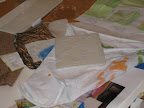

Lauren, who is an art teacher, demonstrated the media she has artistically "stressed" to reproduce wrinkling in her classroom. Her greatest success was achieved with tissue paper, clear acrylic medium, and foamboard. She was able to form and maintain wrinkles of the same wavelength when the tissue paper was applied over the acrylic medium to the foamboard. It was really neat to see the applications for the art classroom.
Monday, August 6, 2007

Thursday, August 2, 2007
Thursday August 2, 2007
A much better day in the lab. We met in Hasbrouck Physics Hall this morning at 9 AM to set up the 0.03% surfactant solution at the optical microscope where we take the wrinkling pictures. Jaingshui suggested that we add the surfactant under the water and stir it with the paddle we use to move the film around in the bath, then let it sit for at least 30 minutes. After we set up the solution, we returned to Conte and prepared three films each. The spin coater had been acting up yesterday afternoon, not holding continuous speed, but it is working fine today. Once we each prepare our films, we return to Hasbrouck for the wrinkling experiments. I went first today, and had no trouble floating my first film and running the wrinkling experiment. Dave was able to get one set of data, but Efren's films folded or would not disengage from the glass; this is the problem I had yesterday. We are using a lighter touch cutting the films, and they seem less dirty. At the end of the morning's work, we decide to clean the microscope base, light source, and the dish holding the solution, since we are all noticing dirt in the background. WE spend about a half hour cleaning. We then prepared another 0.03% surfactant solution, and went to lunch.
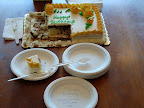
It is Efren's birthday, so we celebrate with cake after lunch. Good stuff! We made three more films each, and each of us is able to get a set of data for analysis. We return to Conte for an afternoon of data analysis using Image J and Origin.
Wednesday, August 1, 2007
Wednesday, August 1, 2007
Only one set of data from yesterday's work can be used; the other films were either dirty or did not have smooth edges. Any artifact in the film can affect the wrinkling. This morning, we each make three more films and carry them to Hasbrouck. We prepare another 0.03% surfactant solution. Dave and Efren have success floating and wrinkling films, but none of my films will separate from the slides. The films are cut and do begin to separate, but then they fold back on themselves and will not free themselves from the substrate. Trying to figure out my problem, we realize that my films were on the top of the pile during transport to Hasbrouck and were exposed to the sun and the heat during the transport; Jiangshui thinks this is the problem. I return and try to make more films, but the spin coater is throwing the slides off of the base. Jiangshui thinks the O-Ring is worn in one area, so this afternoon we will try anchoring the slides in a different area on the base.
After lunch, we each prepared two more films. Jiangshui's hypothesis about the worn spot on the O-ring appears to be valid; we are orienting the slides differently and they are staying on the platform. In addition, we covered the films during transport so that the sun would not affect them. We added 1.2ml of 5% surfactant to 200 ml of water and waited 20 minutes for equilibration. Jiangshui felt that we may be scoring the film too hard and are kicking up glass fragments onto the film, that is why they are all looking so dirty. He suggested that we use a lighter touch while cutting, so we try that this afternoon. Not one of us is able to successful float a film. We are continuously told that there are far more bad days with research than good days, and today seems to be one of those bad days. No meaningful data was generated.
Tuesday July 31, 2007
We begin an actual experiment, determining the effect of surfactant concentration on wrinkling. We made three slides each, then floated them on a 0.03% solution of surfactant, adding 0.2ul drops of water to incur wrinkling. The wrinkles are longer with surfactant in the water; we can see this without analyzing the data with Image J. We have problems with the films however, many are dirty. At the end of the day, Jiangshui added about 5 ml of surfactant to the water and you could see the wrinkles change as the surfactant dissolved into solution - they not only increase in length, they seem to increase in amplitude. Jiangshui is trying to discover a way to measure the change in amplitude in hopes of uncovering an explanation for it.
Monday, July 30, 2007
Monday July 30, 2007
This video was referenced last Tuesday when Jiangshui gave his paper presentation. It represents a drop of colored water on a thin triangular polymer film causing a phenomenon called "Capillary Origami." It was taken from "Capillary Origami:Spontaneous Wrapping of a Droplet With an Elastic Sheet" by Charlotte Py, Paul Reverdy, Lionel Doppler, Jose Bico, Benoit Roman, and Charles N. Baroud from Phy.Rev.Lett.98.156103 (issue 13 April 2007).I think it is really cool!
This morning, it is necessary to recalibrate the Tensiometer to water first, as it was used in another application over the weekend. We prepared a new 0.09% surfactant solution, then did three runs to determine its surface tension. The three readings were averaged, and the surface tension of the 0.09% solution is 46.5. Jiangshui now wants us to float films on water with surfactant added. We calculated how much of the 5% surfactant stock solution we needed to add to 200 ml of water to achieve the desired surfactant concentration. We will be counting the wrinkles on films floating on 0.03%, 0.08%, 0.12% and 3% surfactant solutions. Jiangshui's surface tension readings for the various surfactant concentrations are different from our readings.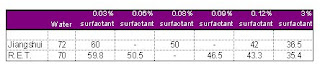
Tomorrow we will prepare films, float them on the various surfactant concentrations, and count wrinkles!
Friday, July 27, 2007
Friday July 27, 2007
Efren and I arrived by 9 to set up the 0.12% solution for three tensiometer readings. The first result is 40, the second run gave us 44, and the third run gave us 42.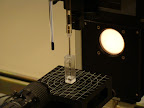
Jiangshui then suggested that we determine the surface tension of a 3% sample. This seems to be quite a jump in concentration, but he wants us to see that there is a limit to the effect of surfactant concentration on the surface tension of water. We will investigate both .30% and 3%.
At 10 am we attend the dissertation defense of Edwin P. Chan, a member of Dr. Alfred Crosby's group. This is Dr. Chan's fourth year; upon receipt of his degree today, he will do postdoctoral work at M.I.T.. His dissertation, "Adhesion of Patterned Polymer Interfaces", was inspired by nature; specifically the ability of beetles, bugs, and geckos to climb up walls.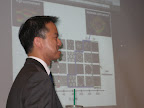
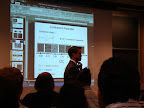
He examined research that indicated that as the mass of the organism increases, the number of setae per area increases while the diameter of each seta decreases. In addition, the shape of the setae vary in nature, some are nearly round (bugs) while others are nearly triangular (gecko). Edwin compares adhesion using a single smooth surface to a surface with a patterned series of posts, then he varies the size, number, and shape of the posts to see the effects of these changes on adhesion. After this work was concluded, he determined that the establishment of these patterns was both labor intensive and expensive, so he sought another means to establish a pattern of adhesion posts. He then investigated wrinkling. He was able to establish a relationship between wrinkling pattern, pattern orientation, and the area being subjected to the stress that causes wrinkling. This provides a quick, inexpensive, and simple way to affect adhesion. This was an extremely interesting presentation, and Dr. Chan's knowledge and ability to explain precisely what he had done, what it meant, and the mathematical and scientific principles behind it on multiple levels was so impressive. I did not feel lost at any time, even though all of the math he presented was most assuredly way over my head. He could rapidly go from gecko feet to Young's modulus and back again, explaining why wrinkling would increase adhesion.
We returned to the lab to set up another reading for the 0.12% solution, then went to lunch. The usual Friday fare was followed by a 4th year PhD candidate's explanation of her work. Liz is a graduate of Carnegie-Mellon with a degree in Chemistry.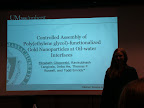
She is working on nanoparticles for drug delivery systems, concentrating on the use of gold and PEG (polyethylene glycol) nanoparticles, which are amphiphilic and aggregate at an oil/water or nonpolar/polar liquid interface. We then returned to the lab to complete our work with the tensiometer.
Thursday, July 26, 2007
Thursday July 26, 2007
Today the tensiometer is really getting a workout. We are determining the surface tension of the solutions we prepared yesterday, each concentration in triplicate. The 0.03% solution results from yesterday are 59, 60, and 61. We are satisified that this surface tension is around 60.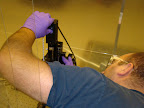
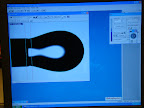
We then empty the 0.03% solution from the syringe, and rinse the syringe three times using the 0.06% solution. We then set up the tensiometer to take three readings on this solution, and the surface tension of the 0.06% solution was determined to be 50, 51.5, and 51, so the average surface tension is 51 for 0.06% surfactant solution. We will continue with the remaining solutions tomorrow.